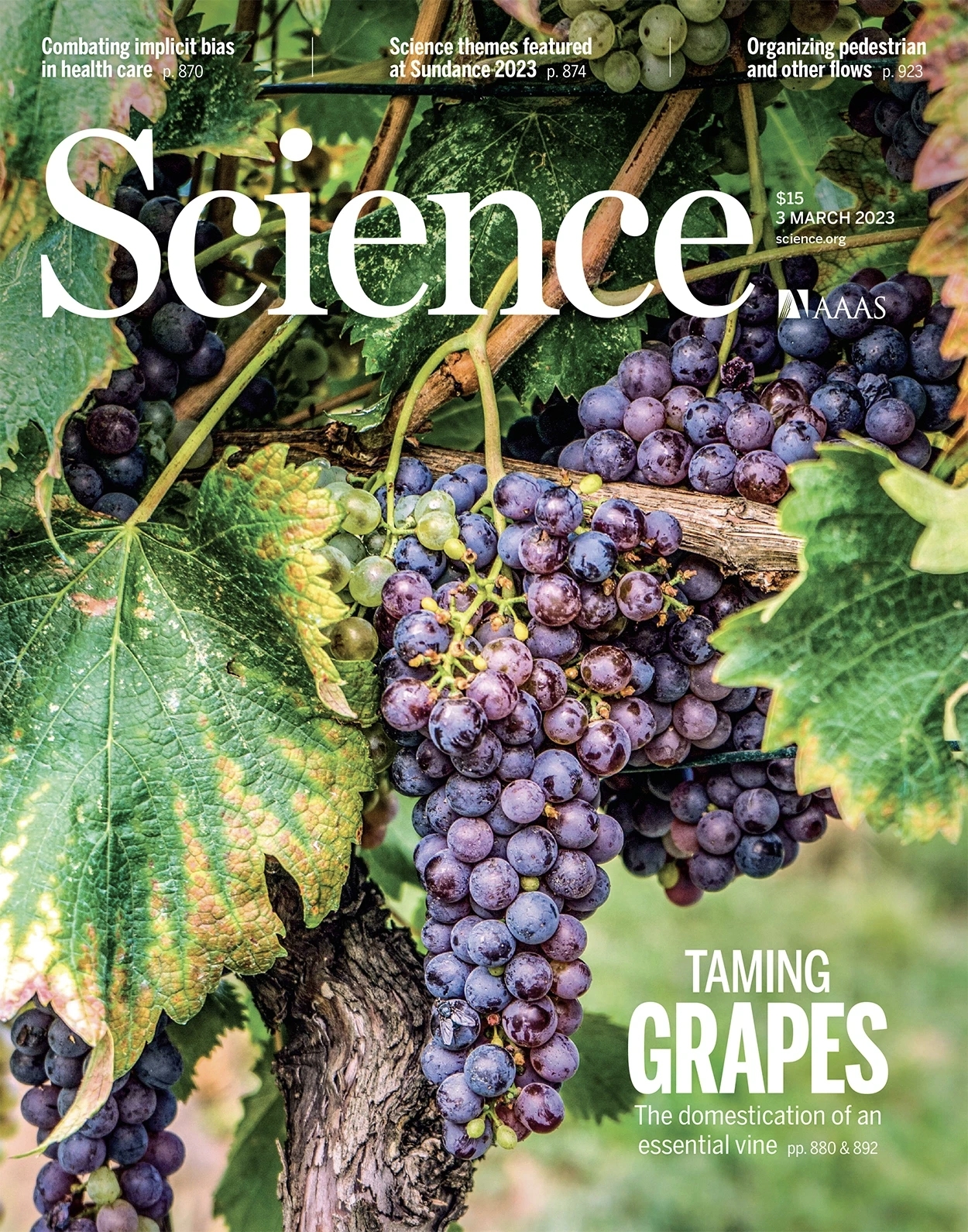
Supported by the Yunnan Provincial Department of Science and Technology, Yunnan Agricultural University, the State Key Laboratory for Conservation and Utilization of Bio-Resources in Yunnan, and the Yunnan Key Laboratory of Biological Big Data, Professor Yang Dong's team at Yunnan Agricultural University took the lead in initiating the Grape Global Genetic Resource Analysis Project (Grape4K Genome Project), in collaboration with more than 70 scientists from multiple countries worldwide. The project focused on fundamental scientific questions regarding the origin, domestication, and dispersal of grapevine, as well as long-debated issues in academia. Using ultra-large-scale genomic data and complex analytical methods, the team thoroughly resolved the questions of grapevine origin and migration over a three-year period, corrected multiple controversies in grapevine research, established a consensus view on grapevine origin and migration, effectively rewrote the textbook on grapevine research, and constructed genomic and phenotypic big-data systems applicable to grapevine breeding—spanning the entire process of artificial selection and improvement. The flagship achievement of this project was accepted and published by the journal Science as a long research article (Yang Dong, et al., Dual Domestications and Origin of Traits in Grapevine Evolution, Science), officially published on March 3, 2023, as the cover article of that issue. The team was also invited to present at the 2023 Science Annual Meeting of the American Association for the Advancement of Science (AAAS), featured as both a conference poster and a recommended research achievement, with a global media briefing organized by Science Press.
Building upon these data, our laboratory team is currently advancing Phase II of the project. The work plan includes: comprehensively analyzing genes controlling economically important traits in grapevine through pan-genome technology; mining superior genes controlling key economic traits through functional genomics research; investigating post-domestication improvement, transmission, and dispersal of grapevine through ancient DNA sequencing technology; and establishing grape genome-assisted breeding techniques through the development of grape breeding chips. All of the above work is progressing efficiently, and we believe it will yield a series of important scientific and applied achievements in the future, filling gaps in China's grape research field and consolidating our province's advantages in grape research. The Grape4KG Project led by our laboratory has established the laboratory's international leading position in the field of grape genetic resources. These advantages in data and genetic resources will translate into scientific research strength and distinctive features in the coming years.
On this basis, we have mined a large number of genes related to artificial domestication in grapevine, developed a 170K grape genome-assisted breeding chip (with three patent applications filed), and established the Plateau-Characteristic Grape Genetic Resource Nursery of Yunnan Agricultural University, preserving more than 1,500 varieties. The accumulation of these resources will provide essential materials and data for the laboratory's development of new grape varieties and for addressing the "bottleneck" problem of domestic grape variety scarcity.
The Yunnan Key Laboratory of Biological Big Data and the Grape Digital Genetic Resource Nursery of Yunnan Agricultural University conduct ex situ field conservation of introduced varieties and collected wild materials, covering 28 mu (approx. 1.87 hectares), making it the largest grape germplasm resource nursery in Southwest China. Over the past three years, with the support of its host institution and in collaboration with domestic and international partners, the nursery has established: (1) a quantitative evaluation technical system for stress resistance and hereditary traits of grape varieties, and (2) a domestication and cultivation technical system for wild grapevines. It possesses ultra-low-temperature facilities covering 500 m², including large liquid nitrogen tanks and ultra-low-temperature freezers. The cultivation facilities equipped at the nursery include:
Wild Vitaceae resource conservation nursery: 5 mu (3,330 m²);
Variety resource conservation nursery: 10 mu (6,666 m²);
Rootstock resource conservation nursery: 5 mu (3,330 m²);
Rare resource conservation nursery: 4 mu (2,688 m²);
Breeding and hybridization nursery;
Propagation nursery: 4 mu (2,688 m²).
Total: 28 mu.
The Yunnan Grape Digital Genetic Resource Nursery has become the largest grape germplasm collection nursery in Southwest China, providing fundamental infrastructure for grape germplasm innovation, breeding, and seed propagation. Domestically, it collaborates with China Agricultural University, Zhengzhou Fruit Research Institute of the Chinese Academy of Agricultural Sciences, Institute of Forestry and Pomology of Beijing Academy of Agriculture and Forestry Sciences, Shanxi Agricultural University, Shanghai Jiao Tong University, and Northwest A&F University, among other universities and research institutes, to introduce grape variety resources and mine novel and distinctive traits. Internationally, it introduces varieties or intermediate breeding materials from breeding institutions in the United States, Japan, and other countries, joining forces with domestic and international peers to carry out breeding work, thereby forming a new team for grape breeding and seed propagation. The nursery has collected more than 1,000 accessions of grape germplasm and varieties from tropical regions, alpine regions, the Tibetan Plateau area, East Asia, and North America, including muscadine grapes (Vitis rotundifolia), characteristic rootstocks, and ancient trees along the Belt and Road. It mines germplasm resources suitable for high-, mid-, and low-altitude areas, arid and humid-hot regions, and alpine zones, providing appropriate germplasm and varieties (lines) for various grape ecological zones nationwide. This nursery serves as a scientific research base for national medium- and long-term germplasm resource innovation and the creation of new germplasm. According to surveys, the main domestic institutions currently collecting grape germplasm resources are Zhengzhou Fruit Research Institute, Beijing Institute of Botany, Shanxi Agricultural University, and Yunnan Agricultural University, with Yunnan Agricultural University possessing the richest collection in the southwestern region. The uniqueness and diversity of wild grape resources in Southwest China, combined with Yunnan's climatic suitability, provide favorable geographical conditions for the construction, conservation, and utilization of national grape germplasm resources, while also offering germplasm sources for the development and expansion of the Belt and Road Initiative. Using the germplasm resource nursery as a demonstration site for rural revitalization, the park integrates technology demonstration, sightseeing tourism, and picking experiences. Through scientific research displays, science popularization, and the integration of agriculture, tourism, and research, it develops new models for rural revitalization.
Research Directions
Grape Bioinformatics and Big Data Research
👤 Yunnan Key Laboratory of Biological Big Data
📅 八月 06, 2026
👁 Views 18
Summary:Yunnan Province is the most important early-maturing grape production region in Asia and the province with the fastest growth rate in table grape planting area in China. Its unique vertical climate zones and abundant dry-hot valleys provide the province with both development opportunities and competitive advantages in both table and wine grapes.
In recent years, Yunnan's grape industry has developed rapidly. In particular, since 2010, the planting area has increased dramatically. Between 2010 and 2015, Yunnan added nearly 400,000 mu (approx. 26,667 hectares) of new grape cultivation area, ranking first in the nation in terms of incremental growth. By the end of 2015, the total grape cultivation area in Yunnan Province had reached 560,000 mu (approx. 37,333 hectares), with a total output of 1 million tonnes. Of this, table grapes accounted for 500,000 mu (approx. 33,333 hectares), yielding 950,000 tonnes. The yield per unit area was the highest in the country, with an average yield of 1,500–2,000 kg per mu and a maximum yield reaching 5,000 kg per mu.
However, behind this rapid industrial growth lies a hidden crisis: the contradiction between industrial economic expansion and the scarcity of resources and germplasm varieties.