In April 2023, in Horticulture Research, Professor Yang Dong's team and Professor Zhang Caixi's team co-published a research paper titled "Chromosome-scale genome assembly of Prunus pusilliflora provides novel insights into genome evolution, disease resistance, and dormancy release in Cerasus L." The team selected a wild fine-flowered cherry (Prunus pusilliflora) tree over 120 years old from a mountainous area on the western Yunnan border. Using ONT, Hi-C, and Illumina sequencing data, they completed the first chromosome-level genome assembly of wild fine-flowered cherry and performed subsequent annotation and analysis. This study obtained a chromosome-level reference genome of fine-flowered cherry with a size of 309.62 Mb, annotated 33,035 protein-coding genes, and identified 49.08% of the genome sequence as repetitive sequences. Comparative genomic analysis revealed that fine-flowered cherry, mountain cherry (P. serrulata), and Japanese late cherry (P. yedoensis) share a relatively close kinship, with species divergence estimated to have occurred approximately 41.8 million years ago. The study found that fine-flowered cherry possesses more NBS-type resistance gene analogs (RGAs), which may be a key factor in its high disease resistance. Phenotypic experiments further demonstrated that fine-flowered cherry exhibits stronger resistance to Colletotrichum, Phytophthora capsici, and Pseudomonas syringae (Figure 25). This research not only provides new perspectives for understanding the genetic background and evolutionary history of fine-flowered cherry but also, through characterization of its high-disease-resistance genes, provides important genetic resources for breeding disease-resistant cherry varieties.
Building on the high-disease-resistance research of fine-flowered cherry, the team further expanded its research scope and conducted studies on the fruit firmness of Chinese cherry (Prunus pseudocerasus). The results were published in Horticulture Research in June 2024 under the title "Haplotype-resolved genome assembly for tetraploid Chinese cherry (Prunus pseudocerasus) offers insights into fruit firmness." Using the Chinese cherry cultivar "Zhuji Duanbing" as the main material, this study completed a haplotype-resolved genome assembly of Chinese cherry. The study found that the four haplotypes of Chinese cherry showed high consistency in collinearity, sequence information, gene structure, and expression levels, suggesting it is an autotetraploid.
Based on the foundations of the first two studies, the team also conducted in-depth investigations into the genetic diversity and flower development mechanisms of Central Chinese cherry (P. conradinae). This study completed the first high-quality chromosome-level genome assembly of P. conradinae, annotating 31,134 protein-coding genes. The study found that repetitive sequences accounted for 46.23% of the genome, with LTR-RTs being the main repetitive elements. Structural variation analysis revealed collinear segments between P. conradinae and other Prunus species, as well as structural variations such as chromosomal inversions and translocations, demonstrating the genetic diversity and complexity among species. Phylogenetic analysis showed that P. conradinae is most closely related to bellflower cherry (P. campanulata), with a divergence time of approximately 19.1 million years ago. P. conradinae also experienced a whole-genome duplication event shared with other Rosaceae species, occurring approximately 138.6 million years ago. Additionally, identification and analysis of the MADS-box gene family revealed the expansion of the SVP gene family related to flowering time and dormancy regulation, providing new clues for studying the early-flowering molecular mechanism of P. conradinae. This achievement was published in Molecular Horticulture in July 2024 under the title "Chromosome-level genome assembly provides insights into the genetic diversity, evolution, and flower development of Prunus conradinae."
The team's achievements in cherry research cover genome assembly, genetic diversity, fruit firmness, flower development mechanisms, and disease resistance of Chinese cherry, Central Chinese cherry, and fine-flowered cherry. These studies not only provide an important foundation for molecular breeding of cherries but also offer new perspectives for understanding the evolutionary history and biological characteristics of related Cerasus species. Furthermore, in terms of genome research on Prunus plants, the team has performed whole-genome resequencing on 384 Prunus samples and conducted pan-genome research on Prunus plants. Currently, the team is using pan-genome data of Prunus plants to reveal intraspecific genetic diversity and complexity. It is expected that this research will help identify and understand genes controlling diversity traits in Prunus plants. Through pan-genome analysis, it is hoped that the molecular basis of these traits can be better understood, providing new strategies and tools for molecular marker-assisted selection and genomic selection breeding.
In 2026, in collaboration with Professor Zhang Caixi / Professor Jiu Songtao's team from Shanghai Jiao Tong University / Key Laboratory of Cherry, National Forestry and Grassland Administration, and domestic and international collaborators, the team published a research paper titled "Pangenome and resequencing analyses reveal flowering evolution and genetic control in Cerasus" online in the international academic journal Nature Communications. This study constructed a high-quality pan-genome resource, CERASUSpan v1.0, covering multiple species of the subgenus Cerasus. From the pan-genome and population genomics perspectives, it systematically resolved the genetic basis of flowering time differentiation and environmental adaptation in the subgenus Cerasus, and revealed the genetic mechanism of the PavBPC6–PavAGL9 module in cherry flowering regulation, providing important genetic resources and candidate molecular targets for perennial fruit tree phenological adaptation research, precise flowering period regulation, and cherry molecular design breeding.
Research Directions
Collection and Analysis of Biological Big Data for Cherry Blossoms and Cherries
👤 Yunnan Key Laboratory of Biological Big Data
📅 八月 06, 2026
👁 Views 17
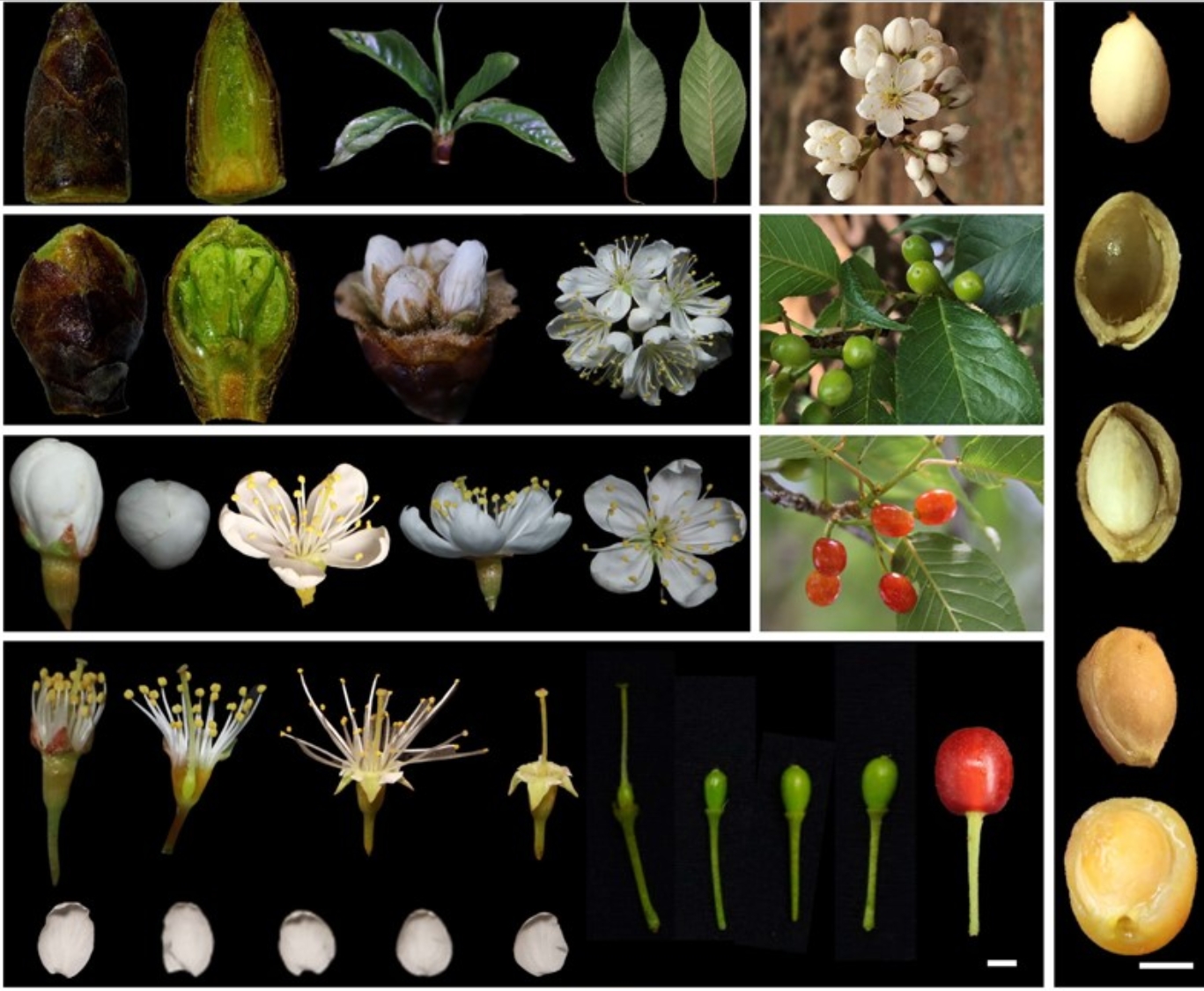
Summary:In recent years, Professor Yang Dong's team at Yunnan Agricultural University has achieved a series of important results in the field of cherry (Cerasus) research. Through close collaboration with Professor Zhang Caixi's team at Shanghai Jiao Tong University, both sides have jointly advanced the depth and breadth of Prunus research.